Project Budget Contingency: How Much Buffer Should You Add?
Don't know how much buffer to add to your project budget? Learn contingency calculation methods, what your buffer should cover, and how to manage it effectively.
Project budgets have a funny habit of looking perfect right up until the project starts. Then a supplier changes its quote, a task takes twice as long as planned, or someone discovers that the “small” requirement was actually three weeks of work. Suddenly, that neat little budget spreadsheet is having a bad day.
A project budget contingency gives you some breathing room when costs refuse to stick to the plan. The tricky part is deciding how much to set aside. Too little, and one unexpected cost can throw everything off. Too much, and you are padding the budget without a clear reason.
So, how much buffer should you actually add? 5%? 10%? 25%?
What Is a Project Budget Contingency?
A project budget contingency is money set aside to cover extra costs caused by project risks and uncertainty.
Think of it as a financial cushion around your planned budget. If your team estimates that a project will cost $50,000, you might add a $5,000 buffer. Your budget would look like this:
- Planned project cost: $50,000
- Budget buffer: $5,000
- Total project budget: $55,000
But hey, don’t get too excited when you see that extra $5,000 sitting there. It’s not your shopping voucher. The money is there for unexpected costs that come from the risks you’ve identified.
The important part is that the buffer should have a reason behind it. You are not throwing a random pile of money into the budget and hoping for the best.
Extra Budget? Isn’t That a Bit Much?
“If we already estimated the project cost, why are we adding more money to it?”
Because projects rarely follow the spreadsheet perfectly. Prices change, tasks take longer, and small issues can get expensive. As a part of a project contingency plan, budget contingency helps you:
- Handle unexpected costs
- Protect the project budget
- Plan for known risks
- Make better estimates
- Avoid painful budget cuts
- Keep everyone on the same page
How Much Contingency Should You Add to a Project Budget?

The Popular Answer: Just Add Around 10%
According to PMI, an average starting point to define the contingency budget starts around 10%. You can choose a percentage around that starting point depending on how much uncertainty your project has.
For example, if your project budget is $50,000:
- 5% buffer: $2,500
- 10% buffer: $5,000
- 15% buffer: $7,500
You pick a percentage, do the math, and move on with your life.
The problem? There is no contingency percentage that works for every project.
Different projects have different risks, so the right percentage depends on what you’re actually dealing with. It’s not a fixed point.
The Truth: Your Risks Should Decide the Number
The right contingency depends on what could actually go wrong with your project. Consider things like:
- Project complexity: More moving parts can mean more opportunities for costs to change.
- Risk exposure: More identified risks can call for a larger buffer.
- Estimate uncertainty: If your cost estimates are still rough, you may need more room.
- Project duration: Longer projects have more time for prices, resources, and requirements to change.
- Resource availability: Limited or expensive resources can create additional cost risk.
- Supplier and external costs: Vendor prices, materials, contractors, and other outside costs may be harder to predict.
- Historical data: Previous projects can show how far actual costs tend to drift from estimates.
So instead of asking, “Should we add 10%?”, a better question is:
“What could make this project cost more, and how much would those risks cost us?”
How to Calculate Project Budget Contingency
Method 1: Percentage-Based Calculation
For a lot of service teams, including IT, this is the simplest way to estimate a contingency. Choose a percentage of the base project budget and set that amount aside as your buffer.
Contingency = Base Project Budget × Contingency Percentage
For example, if your project budget is $80,000 and you use a 10% contingency:
$80,000 × 10% = $8,000
Your total budget would be: $80,000 + $8,000 = $88,000
The catch? Where did that 10% come from? A percentage is quick and convenient, but it can be pretty risky if it isn’t based on your project’s risks, past data, or other evidence.
Method 2: Risk-Based Calculation
Instead of picking a percentage and hoping it makes sense, you can calculate your contingency based on the risks you’ve identified. One common approach is EMV.
EMV = Probability of Risk × Potential Cost
For example:
| Risk | Probability | Potential Cost | EMV |
|---|---|---|---|
| Supplier delay | 30% | $5,000 | $1,500 |
| Additional development | 20% | $10,000 | $2,000 |
| Price increase | 25% | $4,000 | $1,000 |
| Total | $4,500 |
Add the EMV of each identified risk, and you get an estimated $4,500 contingency.
The advantage? Your buffer is based on actual risks and their potential costs, rather than picking a percentage out of thin air.
Method 3: Historical Project Data
Your previous projects are sitting on a pile of useful information. You just have to look at it. Review similar completed projects and compare:
- Original estimated cost
- Actual final cost
- Project size and duration
- Resource requirements
- Major risks
- Causes of cost overruns
- Contingency originally allocated
- Contingency actually used
For example: Your team reviews five similar projects and finds:
| Project | Estimated Cost | Actual Cost | Cost Overrun |
|---|---|---|---|
| Project A | $50,000 | $53,000 | 6% |
| Project B | $60,000 | $64,800 | 8% |
| Project C | $75,000 | $78,750 | 5% |
| Project D | $80,000 | $85,600 | 7% |
| Project E | $100,000 | $109,000 | 9% |
The projects went 5% to 9% over budget, giving the team a useful reference for a similar project. If the new project has a $100,000 budget, the team might consider an 8% buffer ($8,000) as a starting point.
That doesn’t mean 8% is automatically the right answer. Different suppliers, teams, scopes, and risks can change the amount needed.
Historical data is evidence, not a crystal ball.
The Two Types of Buffer That You Should Know
Project budgets have two different safety buffers: contingency and management reserve.
🛡️ Contingency reserve: Money you set aside for problems you can already see coming, even if you don’t know whether they’ll actually happen.
💼 Management reserve: Money kept for the “well, we definitely didn’t see that coming” moments.
| Feature | 🛡️ Contingency Reserve | 💼 Management Reserve |
|---|---|---|
| Used for | Identified risks and cost uncertainty | Unforeseen risks or work |
| Budget position | Included in the cost baseline | Outside the cost baseline, but part of the total project budget |
| Control | Usually managed by the project manager | Usually controlled by management or the project sponsor |
| Calculation | Risk analysis, EMV, historical data, or other methods | Based on overall project uncertainty and organizational practices |
Easy way to remember:
Contingency reserve = “We saw this risk coming.”
Management reserve = “We didn’t see this one coming.”
How Do They Fit Into the Project Budget?
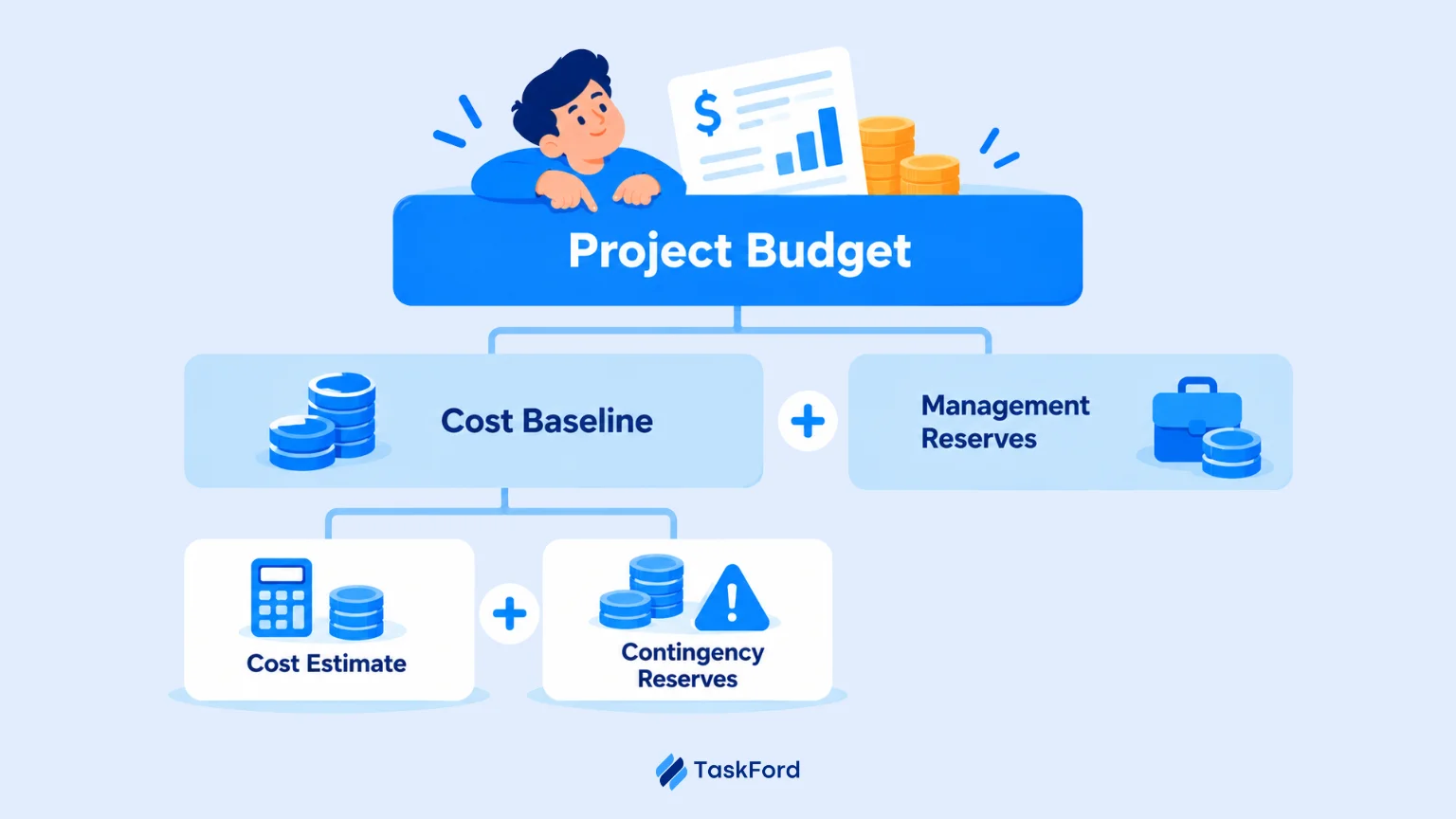
Contingency and management reserves both add breathing room to a project budget, but they sit in different places. The relationship can be simplified like this:
Project Budget = Cost Baseline + Management Reserve
Cost Baseline = Cost Estimates + Contingency Reserve
Source: 5th Edition PMBOK® Guide, Chapter 7
What Should Your Budget Contingency Actually Cover?
What Should Your Contingency Cover?
Your contingency can cover things like:
- Unexpected labor or overtime costs
- Supplier or material price increases
- Additional work caused by identified risks
- Rework or fixes related to project risks
- Schedule delays that create additional costs
- Unexpected contractor or vendor costs
- Additional testing or quality work
Think of it as money reserved for the “well, that wasn’t in the plan” moments you could reasonably see coming.
What Should It Not Be Used For?
Your contingency should not become the project’s “just put it on the buffer” fund. Avoid using it for:
- Costs that were already known but left out of the original budget
- Routine project expenses
- Unapproved scope changes
- General discretionary spending
- Repeatedly covering poor project performance without addressing the underlying issue
You Set the Buffer. Now What?
Setting up a buffer is only half the job. So consider these:
Tips for Managing Project Contingency
1. Compare planned vs. actual spending: budget tracker template can help you keep an eye on planned and actual costs. A growing gap can signal that your forecast needs attention.
2. Record every use of contingency: When you use the buffer, record what happened, which risk caused the extra cost, how much was spent, and how much remains.
3. Keep contingency separate: Make sure the team can clearly see planned spending and reserved funds. Mixing them together makes the budget harder to understand.
4. Review the buffer at key milestones: Review the buffer after major milestones, scope changes, or other events that could affect the cost forecast.
5. Update the forecast: If a major risk disappears, your expected cost exposure may drop. If a new risk appears, you may need to reassess the reserve.
What to Avoid
❌ Applying the same percentage to every project: Different projects have different levels of risk. A standard percentage may be convenient, but it is not automatically accurate.
❌ Choosing a percentage without assessing risk: If nobody can explain what the contingency is supposed to cover, the number probably needs another look.
❌ Adding too little buffer: An unrealistically tight budget leaves little room when a known risk becomes a real cost.
❌ Adding too much “just in case”: A huge buffer can make the project look unnecessarily expensive and hide problems in the original estimate.
❌ Treating contingency as spending money: Unused contingency is not a target. You don’t get bonus points for finding ways to spend it.
❌ Forgetting resource and labor costs: People can be one of the biggest project expenses. Changes in resource availability, rates, or workload can affect the budget too.
❌ Setting the buffer and forgetting about it: The right contingency at the start of a project may not be the right contingency six months later. Keep reviewing it as the risks change.
Project Budget Contingency Checklist
Before approving your project budget, check:
✅ Define the base project budget
✅ Identify major cost risks
✅ Estimate probability and financial impact
✅ Review historical project data
✅ Choose an appropriate contingency approach
✅ Document what the contingency covers
✅ Get budget approval
✅ Track contingency usage
✅ Review remaining contingency throughout the project
✅ Update forecasts when risks change
Once everything is checked off, you have a contingency with a reason behind it, not just a random number in the budget.
Final Takeaway
So, how much buffer should you add? Enough to cover the risks and uncertainty your project actually has.
A percentage can give you a quick starting point. A risk-based calculation gives you a more tailored number. Historical project data can show what tends to happen in similar work. You can also adjust the buffer as the project moves forward and your risks change.
The biggest mistake is treating contingency as a random percentage or extra spending money. Give it a clear purpose, track how it is used, and review it along the way.
Your buffer should have a job. Make sure it knows what it is.
Related Articles







Subscribe for Expert Tips
Unlock expert insights and stay ahead with TaskFord. Sign up now to receive valuable tips, strategies, and updates directly in your inbox.